Profile
Kevin Nguyen

I'm Kevin, a product engineer in Sydney.
- Currently automating credit decisioning at Skip.
- Previously a Senior Engineer at Sauce, working across software, AI and ML.
- Before that, a Senior Front-end Engineer at Mirvac.
- Bachelor of Engineering (Honours) / Commerce from UNSW.
Work experience

Skip
A fintech lender. I work on its AI-assisted credit decisioning platform. skiploans.com.au
- Drove an AI-assisted credit decisioning platform from first build to business buy-in over eight months, authoring the PRDs and now onboarding two engineers to scale delivery.
- Took 80+ automated decision rules from spec to production through shadow mode, per-rule feedback and stakeholder sign-off, with zero tolerance for false positives.
- Delivered ~960 commits across two codebases in a year, spanning the decision engine, document AI, a new internal operations product, and a platform migration.
- One of the company's main external engineering voices, through the engineering blog and conference talks.
Trustworthy AI decision systems
- Designed a rules engine where AI can't silently decide: deterministic checks may pass on their own; anything an LLM reasoned about routes to human review.
- Made every decision replayable and auditable: inputs, rule versions and calculator versions are persisted, so any past outcome can be re-run exactly and every override is traceable.
- Made failures loud instead of silent: each rule declares its data dependencies and fails explicitly when one is missing, rather than passing on incomplete data.
- Built a backtesting CLI used by engineers and coding agents alike, so every rule change is measured against historical decisions before it ships.
- Ran a closed-loop calibration process with domain experts: shadow mode, agree/disagree feedback per rule, QA sampling in production, and automatic demotion of any rule that produced a false positive.
Document AI & LLM evaluation
- Built a multi-provider document extraction pipeline (Claude, Gemini, specialised OCR vendors) covering 15+ document types with schema-validated output.
- Raised extraction trust with ensemble consensus: multiple models vote, a value only counts as verified when independent approaches agree, and disagreement goes to a human.
- Built an LLM evaluation framework wired into CI, with per-document datasets, scoring, and guards that stop errors being reported as results.
- Hardened the pipeline for messy real-world input: provider schema drift, very large or corrupt files, idempotent retries, and dead-letter recovery on a durable workflow engine.
Internal product: operator workspace
- Started and led the next-generation workspace that operators use to review cases (~130 commits), replacing the previous tool.
- Modelled the full review workflow: information requests and follow-ups, conditional approvals, escalation through authority levels, and final decisions.
- Built a multi-pane document viewer with draggable tabs, pop-out windows and in-place filing, designed with the product designer from Figma.
- Designed a contract-first API (a published, typed HTTP contract shared by backend and frontend) and permission-based access control.
- Covered the workflows with ~18 end-to-end scenarios, several driven by coding agents through WebMCP.
Platform & architecture
- Established the team's Effect standards: introduced Effect into the production monolith incrementally (through the 4.0 GA release), with shared patterns, lint rules and team upskilling.
- Defined a domain-driven code layout with lint-enforced boundaries, so architectural rules are checked in CI rather than in code review.
- Built data provenance tracking recording whether every value was declared, extracted or verified.
- Built and open-sourced a durable workflow runtime for AWS Lambda (
effect-workflow-lambda), developed with the Effect core team and running the production document pipeline. - Removed a class of production database deadlocks by restructuring transactional writes.
Product delivery & rollouts
- Replaced a coarse eligibility model with a finer geographic classification end to end (data, APIs, versioned decision records, dashboards), rolled out behind allowlisted flags and then retired the legacy path.
- Integrated third-party identity verification into partner onboarding, making verification a pre-submit requirement and removing redundant manual requests.
- Built a finance reporting service with daily automated reports and accounting/warehouse syncs on event-driven infrastructure.
Engineering effectiveness & DevOps
- Automated production releases: labelled PRs deploy themselves once staging is green.
- Sped up CI substantially: a Rust-based type checker, larger runners, tuned test pools, and slow LLM tests moved to nightly.
- Removed long-lived cloud credentials with OIDC and blocked new secrets at PR time.
- Improved observability and local development: tracing, dashboards and SLA alerts in production; local telemetry and shared seed data for development.
AI-native engineering & leadership
- Built SAO, an internal platform for running many AI coding agents in parallel across repos: session lifecycle, agent state detection, ticket sync, PR review routing, and cost and rate-limit tracking.
- Designed systems for agents as first-class users: structured-output CLIs,
AGENTS.md, repo skills, and agent-driven end-to-end testing. - Wrote the product requirement docs for the decision platform; writing them surfaced wrong assumptions in the code, which I then fixed.
- Presented the platform to company leadership and shaped team practice: standups, PR and review standards, and architecture direction.

Sauce
An AI product-feedback analytics platform. I worked across product, AI and infrastructure. LinkedIn
- Made analytics queries fast at scale by introducing ClickHouse as the analytics engine end to end, taking heavy queries off the primary database.
- Removed two production systems (a Kubernetes cluster and a vector database) by replacing them with simpler managed alternatives, cutting operational load and cost.
- Replaced GPU-hosted ML models with hosted embedding APIs, right-sizing infrastructure and removing a heavy dependency chain.
Product & AI
- Designed and built a multi-step research agent across backend, API and frontend, with a post-processing step that made AI-generated reports consistent.
- Re-architected the Python ML service from flat scripts into a modular, typed API consumed by the TypeScript backend through a generated client.
- Built a tuned keyphrase extractor that held up under production load.
Infrastructure & delivery
- Provisioned a new isolated service end to end with infrastructure-as-code (network, database, containers, load balancer, CDN) and multi-environment CI/CD.
- Connected services to the analytics database over private networking and routed critical alarms to Slack.
- Introduced a semver release process with automated release notes, and AI code review in CI.
- Hardened multi-tenancy with indexed tenant scoping across all relational tables and safe batched backfills.
Frontend
- Upgraded the main app to React 19 and adopted a composable component library.
- Shipped a personalised feed and a table view with sorting, filtering and bulk actions.
- Upgraded the browser extension to Manifest V3.

Mirvac
A major Australian property group. I built its customer-facing web and mobile apps. mirvac.com
- Achieved "Employee of the Quarter" for delivering mobile of allowing users digital access through the app.
- Led and implemented marketing website for a new building roll out, generating $500K in converted leads.
- Improved upgrade efforts of mobile app by moving to Expo prebuilds, reducing upgrade migrations from hours of manual diff checking to an automated 10 seconds CLI command.
- Improved React/code base by refactoring home-made solutions to industry libraries (react-query, react-table, and shadcn/ui).
- Improved React build time by 80% by switching from CRA to Vite and using Bun for Github Actions, reducing an average of 5 mins down to 1 in our CI/CD.
- Mentored new engineers through to their first PRs and provided detailed comments on best practices.
- Managed internal engineer scaling issues by automating several manual processes and providing documentation.
- Built a live retro feedback tool for other teams and initiated a company-wide hackathon.

Atelier
An early-stage Sydney startup. I built its real-time collaboration features across the stack. atelier.co
- Enhanced the front-end by developing reusable components using SASS and Apollo Client, resulting in improved code maintainability and enhanced user experience.
- Implemented a robust backend infrastructure using Prisma, Nexus, and Apollo Server, ensuring seamless CRUD operations and optimal performance.
- Established a comprehensive end-to-end testing framework using Cypress and integrated it with Circle CI, enabling automated testing on every branch push and enhancing code quality.
- Designed and developed a sophisticated messaging system with GraphQL subscriptions and a Postgres pub/sub system, delivering real-time communication capabilities similar to Slack.
- Led the migration of the existing Postgres database to AWS, leveraging the cloud platform's capabilities to enhance control, scalability, and uptime, ensuring a more robust and reliable database infrastructure.

Appian
An enterprise low-code platform. I supported customer deployments across the stack. appian.com
- Demonstrated expertise in supporting various components of the Appian stack, including application servers (Tomcat, JBoss), web servers (IIS, Apache), RDBMS (MySQL/Mariadb), Apache Kafka, Elasticsearch, and integrations with Appian.
- Proficiently handled additional technologies such as AWS Cloud architecture, networking/VPN (IPsec), Linux (SSH/busybox tools), accessibility compliance (WCAG), and resource contention management (CPU/Memory/Threads).
Contract work

Patch
A Sydney town-planning firm. I'm building its geospatial platform for NSW property data. patchplanning.com.au
- Building a full-stack geospatial platform serving NSW cadastre (property parcel) data — lot lookup API, Mapbox Vector Tile streaming, and an ArcGIS REST compatibility layer.
- Designed a zero-downtime snapshot sync flow that imports ESRI FileGeoDatabase exports via GDAL into PostGIS staging tables, validates the snapshot, and atomically promotes it while existing API routes continue serving the previous data.
- Implemented geospatial delivery integrations for Mapbox Vector Tiles, PMTiles served from Cloudflare R2, and a constrained ArcGIS REST-compatible query endpoint.
- Stack: Bun, Effect v4
HttpApiwith schema-derived OpenAPI docs, Drizzle, PostgreSQL 16 + PostGIS (GiST spatial indexing), React 19/Mapbox GL dashboard, and Railway infrastructure-as-code.

Fullsuite
A product agency building for early-stage startups. fullsuite.agency
- Implemented POC with encryption using libsodium CHACHA20-POLY1305 and exposed through Expo Modules.
- Building Auth, Mobile (Expo), Web app (react), back-end (HonoJS, Turso) for a new startup.

- Implemented a Telegram price bot using Node.js, AWS Gateway, AWS Lambda, and Serverless (SLS).
- Developed PitStop, a Next.js application utilizing ethers.js and web3modal for future application efforts.
- Built PitChart, a GraphQL-powered data visualization tool displaying OLHC data over time using react-financial-chart.
Talks
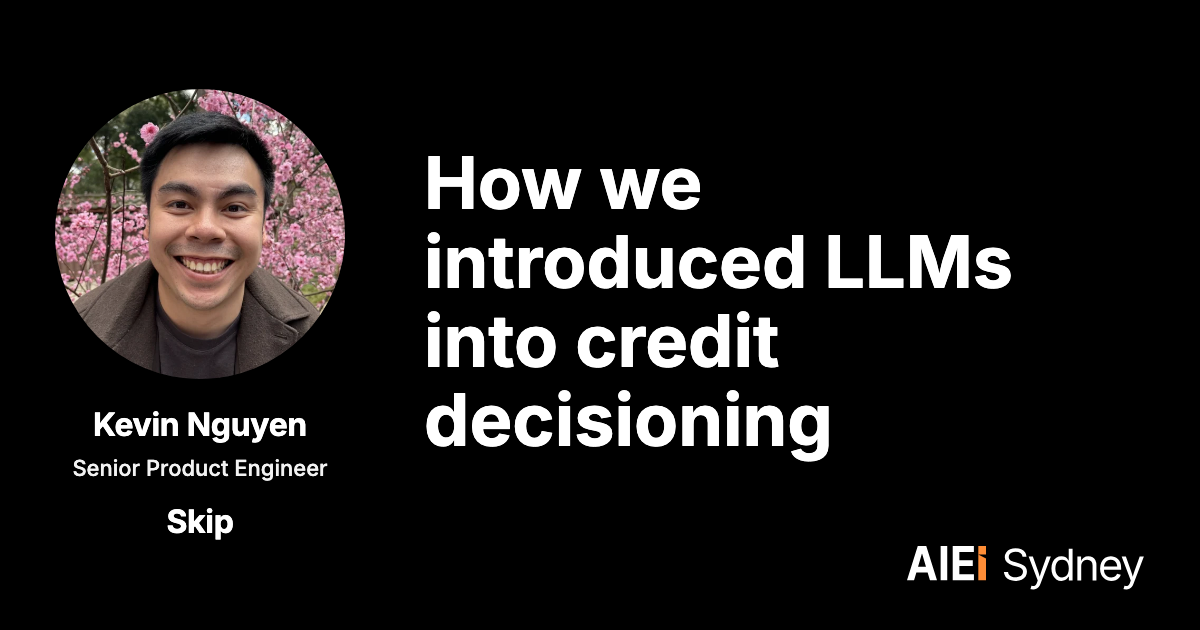
How we introduced LLMs into credit decisioning (safely)
A 25-minute conference talk on bringing LLMs into lending decisions without letting them decide alone: replayable decisions, human review for anything a model reasoned about, and shadow-mode rollout.
Agentic coding workflows and codebase design for AI agents
How to structure a codebase so coding agents can work in it reliably, and the day-to-day workflows that make agentic development productive.

Real-time analytics with Sauce AI and ClickHouse
Co-presented with ClickHouse: how Sauce moved heavy analytical queries off Postgres onto ClickHouse to serve real-time product-feedback analytics.
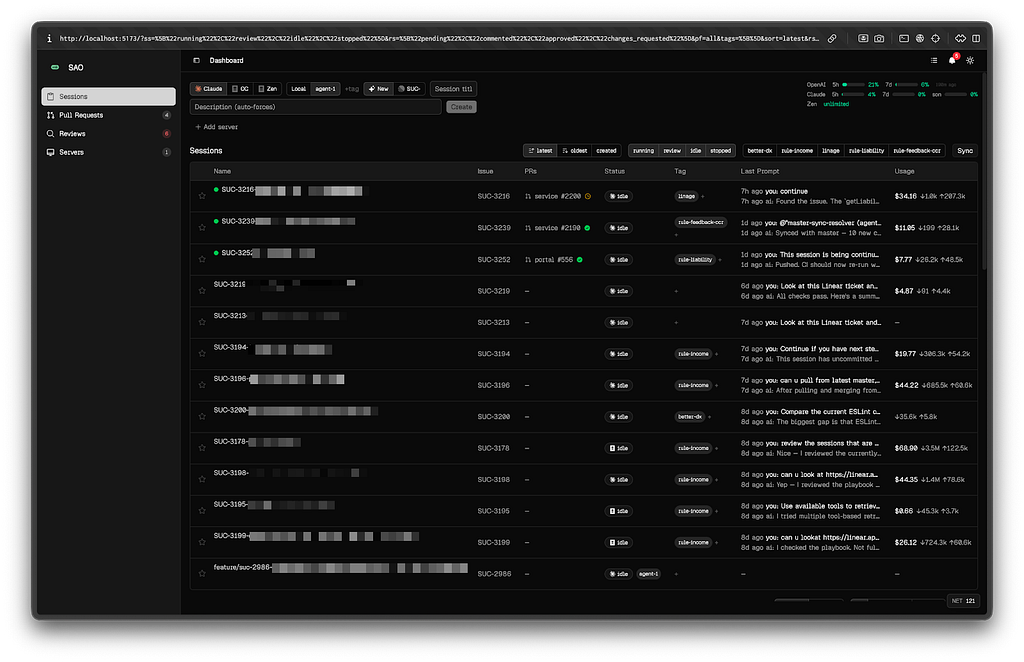
You should build your own agentic harness
Practical principles for making a codebase agent-friendly, written for the Skip engineering blog.
Projects
A durable workflow runtime for Effect on AWS Lambda with pluggable MySQL, Postgres and Redis persistence, developed with the Effect core team. It runs Skip's production document pipeline.

Real-time collaborative messaging with channels, threads, task boards and AI agents across web, desktop and mobile, built local-first on client-side SQLite.
A sync-first task manager on the Evolu sync engine, with keyboard shortcuts driven by xstate/store.
An issue tracker on a browser-local database, with reads and writes under 100 ms and no network round trips.
A team retrospective board using Ably pub/sub, with leader-follower sync between browsers.
A PDF annotator on pdf.js with a recursive, drag-and-drop file tree.